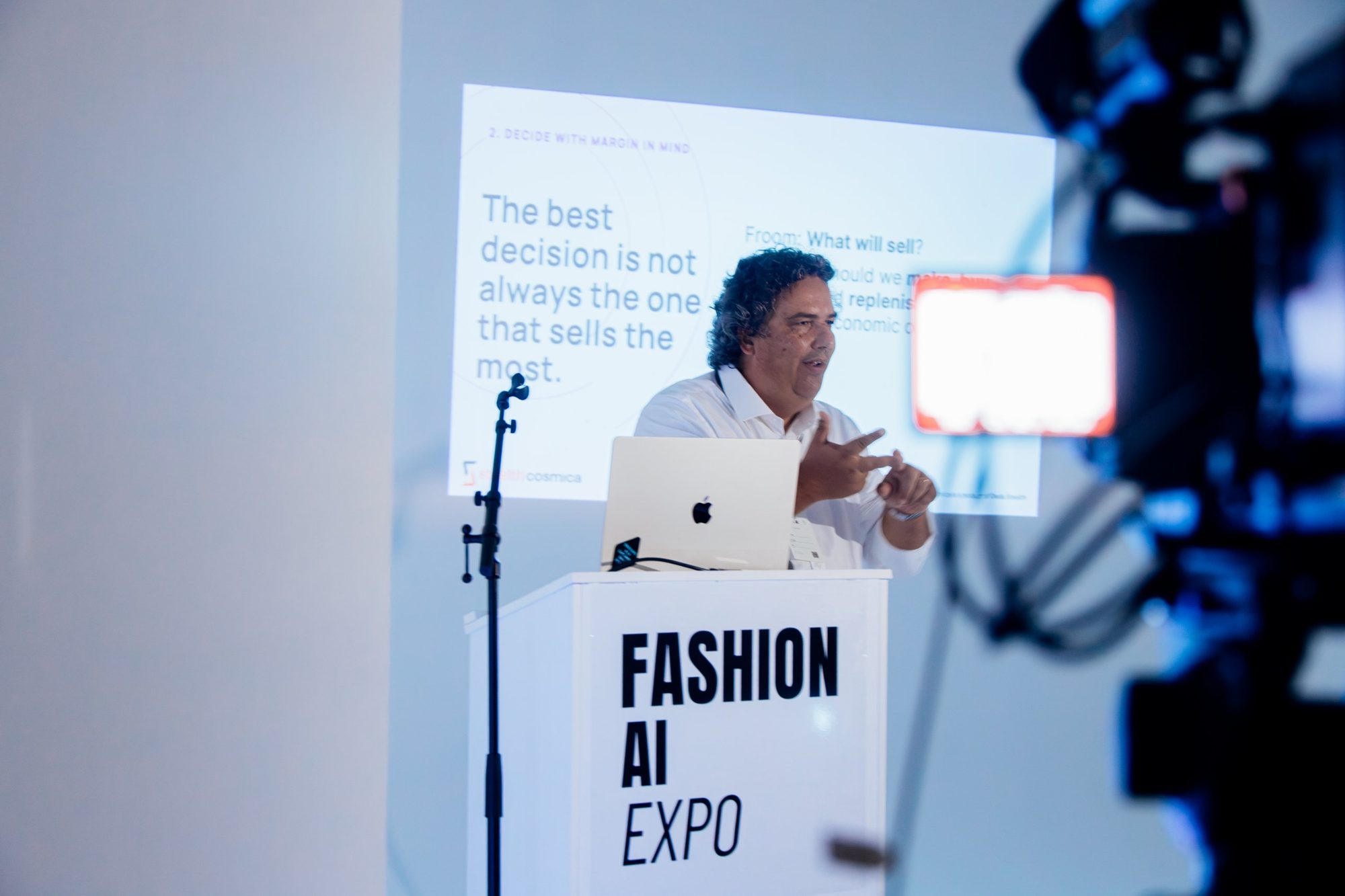
Luca Tonello, CEO of Deda Stealth, speaking at Fashion AI Expo Paris, October 2026
Back to Magazine
Field Notes · Issue No. 06

Beyond Creative AI
Why Operations Is Fashion's Real AI Frontier

At the opening of Fashion AI Expo Paris, Luca Tonello, CEO of Deda Stealth, turned the spotlight away from generated images and toward the machinery behind every collection: planning, production, allocation, resale.

The first voice of the day on 2 October was not a designer or a futurist. It belonged to the man behind the software that runs work orders, production and sales for houses such as Gucci and Armani. Deda Stealth counts more than 40 years in technology and more than 1,000 fashion brands on its platform.

His message was quietly provocative. While much of the room had come for creative AI, Tonello asked the audience to look backstage, where margins are won or lost long before a garment reaches the window.

A System Under Pressure

Luca Tonello opened with a diagnosis: fashion, by which he means apparel, shoes and bags, is under pressure from every side at once.

  • Margins are being squeezed.
  • Speed to market keeps accelerating. The rhythm of two seasons a year has dissolved into capsules, collaborations and continuous drops; he pointed to Moncler, a Deda Stealth client, and its Genius project as a never-ending collection.
  • Personalization at scale is now what customers expect, and only technology can deliver it.
  • Demand is harder to predict than ever, while wholesale, retail and e-commerce still run as separate businesses. Omnichannel, he noted, was the buzzword nobody truly delivered.

Each of these forces lands in the same place: the planning office, where decisions about what to make, and where to send it, are taken under growing uncertainty.

The Quiet Side of AI

Creative AI has the glamour: generated campaigns, virtual models, design assistants. Tonello acknowledged the startups working on it, then drew a clear line. Deda Stealth covers production, planning and execution, the part he called, with a smile, "quite boring."

Boring, perhaps, but decisive. For him, operational excellence is one of the industry's biggest opportunities, because it is where the economics of a collection are set.

He also sees a generational shift coming. Young professionals who studied with an AI tutor will expect the same support at work: help with the day-to-day choices that decide whether the right product is in the right place at the right moment.
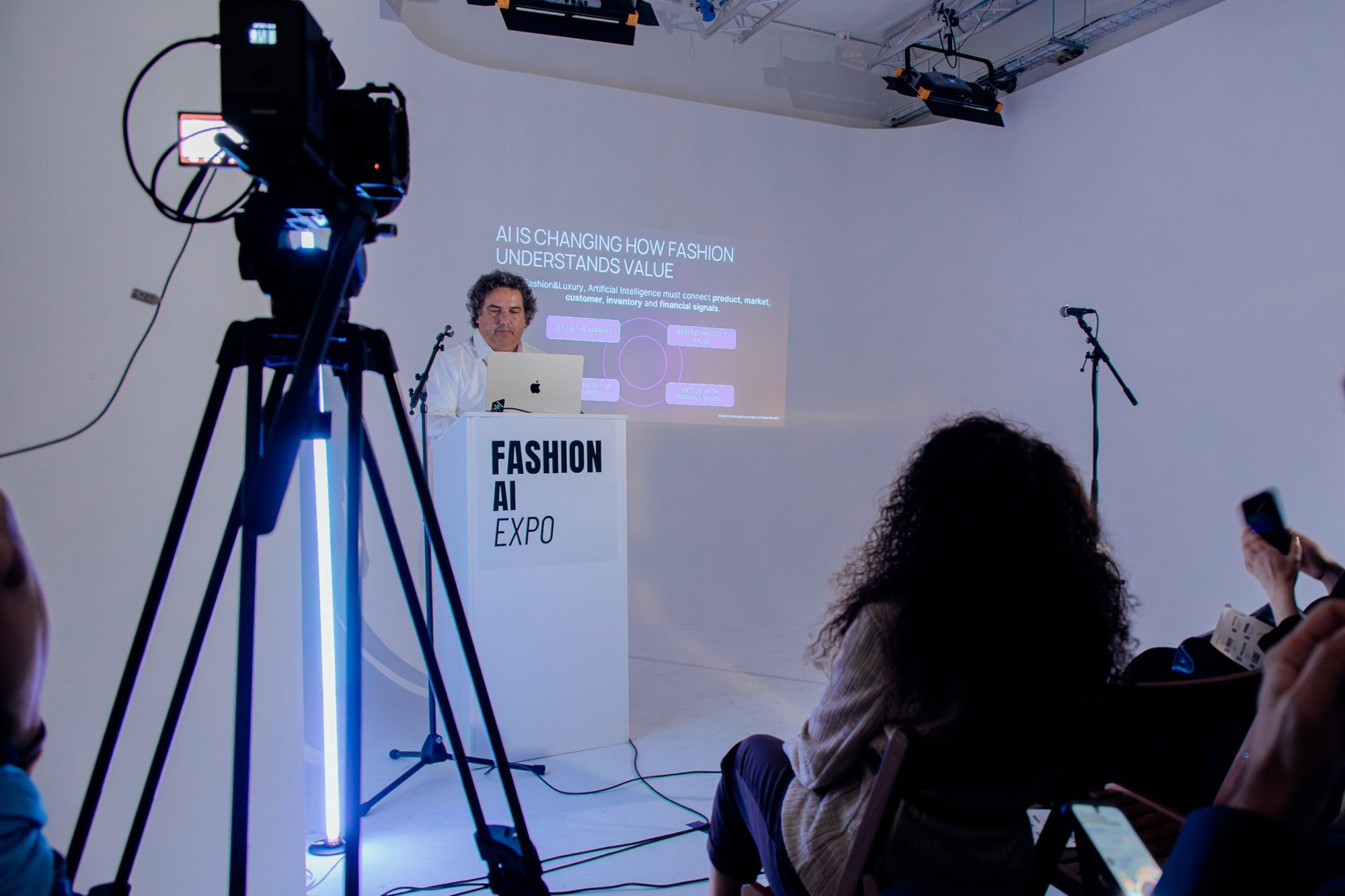
Luca Tonello presenting "AI is changing how fashion understands value" at Fashion AI Expo Paris
Luca Tonello, CEO of Deda Stealth, at Fashion AI Expo Paris, 2 October 2026 — "AI is changing how fashion understands value."

One Business, Many Decisions

The real obstacle, Tonello argued, is fragmentation. Planning, merchandising and finance work in separate departments, on separate technologies, rarely seeing the same picture.

His answer is to bring three moments of the company onto one platform: planning the demand and the budget, launching production, and executing, which means allocating goods according to orders. All of it rests on a single shared inventory, so stock is placed by design rather than by accident. Without that view, he warned, online orders can be fulfilled first while the stores are left empty.

At the centre sits one question for every complex brand, with its many markets, lines and channels: what should we make, buy, allocate and replenish to create the strongest economic outcome?

Answering it requires a new kind of software. Traditional ERPs, in his words, are monolithic and complicated. The new generation must be composable, solving one specific problem at a time, and AI-first, built on a consistent data foundation. "We don't want to put AI into existing systems," he said. "We built a new platform based on AI." That platform is Stealth Cosmica.

"We don't want to put AI into existing systems. We built a new platform based on AI."

After the First Sale

Tonello's recent mantra is simple: the journey of a product does not end at the first transaction. Two of Deda Stealth's newer tools follow that journey into the market.

The first watches price. Built on Competitoor, the price-monitoring specialist Deda Stealth recently acquired, it tracks how a brand's products are priced online, by its distributors and partners, and by its competitors. With some of the largest fashion houses now lowering prices, he said, knowing where a product stands in its category has become essential.

The second, Stealth Revalue, watches resale. Tonello believes brands will sooner or later take control of the second-hand market themselves. Patagonia showed the way, and he counts around 50 brands already running resale in-house, while many French and Italian houses still leave it to third parties.

His reasons are commercial as much as ethical:

  • Gen Z often buys second-hand first, so resale is where a brand meets its next clients.
  • Resale gives end-of-season stock a controlled outlet at lower prices.
  • Upcoming extended producer responsibility (EPR) regulation will make this business grow.

Deda Stealth has also announced a partnership with Trove, connecting Stealth Revalue with Trove's resale technology, which handles reuse and repair within logistics, with traceability of each item as the thread that holds it together.

The Most Common Mistake

At the Milano Fashion Global Summit, Milano Finanza asked Tonello about the most common mistake in AI adoption. He shared his answer in Paris: believing that a piece of software, at the press of a button, will solve a company's problems.

The first thing that matters is the organization, and the people who will use the tool. They have to understand how it handles data, because the quality of every decision depends on it.

He closed with a formula that could stand above any planning office:

"Correct data. Human intelligence. AI as a tool in your hands."

The Frontier Behind the Curtain

The most visible AI in fashion lives on screens and runways. The most consequential may live in spreadsheets, allocation rules and resale flows, where every collection is decided twice: once by the designer, and again by the system that makes, moves and sells it.

That was the point of opening Fashion AI Expo with Deda Stealth. Fashion and technology meet not only in the image, but in the decisions that follow it. For brands, the question is no longer whether to adopt AI, but where. Tonello's answer is to begin with the data, the people, and the decisions in between.

Luca Tonello, CEO of Deda Stealth, spoke at Fashion AI Expo Paris on 2 October 2026, during Paris Fashion Week, at Artistic Palace.

See you in the next article.

Olga Gasnier & Valeryia Belaya
Fashion AI Expo
Previous article
The State of AI in Fashion 2026 →
→