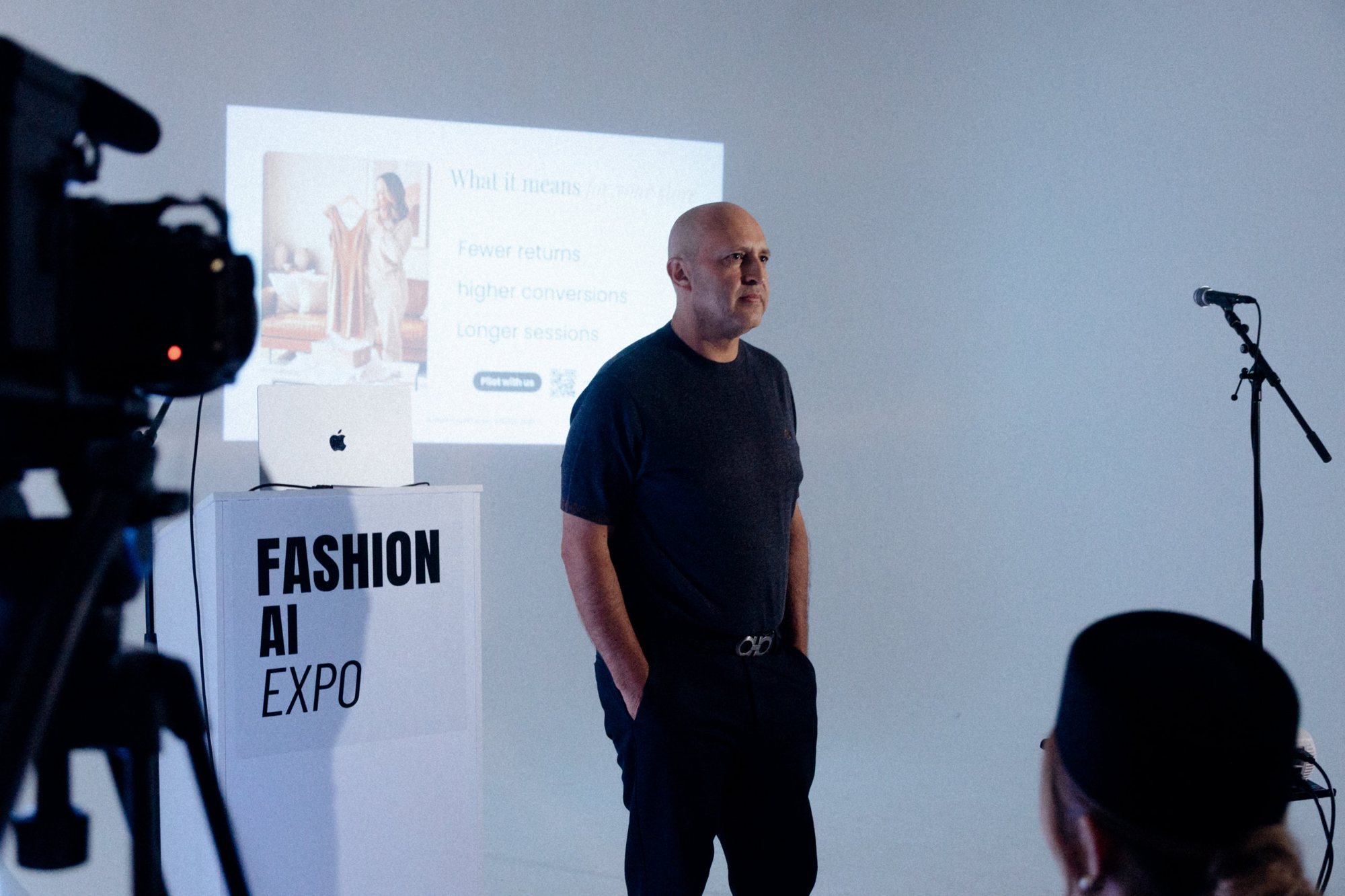
At Fashion AI Expo Paris, Fabian de la Fuente, founder of My Pet Model, made a simple promise: shoppers will soon see themselves in every outfit online, without their photo ever leaving their phone.
The talk came with a rare twist. Through a special collaboration with E.P.P.S., presented in the FAIE showroom, visitors could watch the brand's garments on screen through My Pet Model's virtual try-on, then walk a few steps to see and touch them in reality.
Fabian de la Fuente, a Canadian inventor and investor, founded My Pet Model only four months before the event. His idea turns the usual logic of virtual try-on on its head.
The Missing Person in E-Commerce
Open any online store and you meet the same cast: tall, flawless professional models. "You don't see yourself," de la Fuente told the room. "And what you want to see is yourself."
Virtual try-on was meant to close that gap, but in his view today's tools stumble on three counts:
- Speed. You upload a photo, then wait.
- Quality. AI-generated images often look slightly wrong, and shoppers notice.
- Privacy. You hand over a picture of yourself without knowing where it will go.
Solve one, and the others usually get worse. My Pet Model set out to solve all three at once.
Reversing the Flow
Most try-on tools send your photo to a server, process it there and send back the result. My Pet Model does the opposite.
The shopper takes one photo, once. It stays on the phone, stored on the same secure hardware that protects a fingerprint or face recognition. When the shopper browses a partner store, it is the garments that travel: product images and data come to the device, and the shopper appears in the outfits instead of the model.
We bring the garment to the phone, not your image to the server.
Fabian de la Fuente, My Pet ModelThe photo itself only needs to be good once: standing, on a plain light background, without a hat or a bag, so the system can read the body clearly. From there, the whole catalogue becomes personal.
Behind the Instant Image
Three pieces of engineering make the experience feel effortless.
- Predictive caching. The system anticipates what the shopper is about to see and converts those images ahead of time. By the time a product scrolls into view, the shopper is already wearing it.
- The bakery principle. De la Fuente compared it to a bakery that bakes its bread before dawn, before anyone has ordered. Many images are prepared that the shopper may never look at, so that the ones they do see appear instantly.
- A second pair of eyes. Quality is guarded by a second AI agent that reviews the work of the first. Any image that falls short is rejected and generated again, all behind the scenes. If an image still isn't right, the store simply shows the original model photo. The shopper never sees a failure.
One of the cleverest ideas came from the engineers themselves. Rather than inventing a new pose for every shopper, the system keeps the pose of the model in the original photo, which saves a great deal of computing power. "You put AI guys to work on fashion where they don't know anything," de la Fuente said, "and they come up with fantastic ideas."
Riding the Curve
Preparing images in advance only works if generating them keeps getting faster and cheaper, and de la Fuente's figures suggest it is. Five years ago, an AI image took around 50 generation steps. Three years ago, a single step took 0.2 seconds on a large server. Two years ago, it took half a second on a phone.
Cost has followed the same path. By his account, what cost $100 three years ago costs about $1 today, and he expects it to cost cents next year, the same story phones and computers have told for decades.
He sees the market moving in two stages:
- In the next one to three years, try-on becomes standard. Google, Zara, ASOS and Amazon are already moving in that direction.
- Within five years, shoppers carry a digital size profile, and stores read it to recommend the right fit automatically.
In Europe, that future comes with clear rules. Privacy under GDPR and transparent labelling of AI-generated images are, for My Pet Model, part of the design from day one.
What It Means for Brands
For brands, the promise is concrete: fewer returns, higher conversions and longer sessions. A shopper who has already seen the dress on herself is less likely to send it back, and more likely to keep browsing.
The deeper shift is one of trust. As AI enters the fitting room, the brands that win will be the ones that let customers see themselves without asking them to give themselves away. Keeping the photo on the phone turns privacy from a legal checkbox into part of the experience.
That is what the E.P.P.S. collaboration made tangible at Fashion AI Expo: the same garment on a screen, worn by you, and then on a rail a few steps away, waiting to be touched.
Later that day, de la Fuente joined the panel on AI styling and virtual try-on. Read our notes in From Wardrobe to Checkout.
Fabian de la Fuente spoke at Fashion AI Expo Paris on 2 October 2026, during Paris Fashion Week, at Artistic Palace.
See you in the next article.