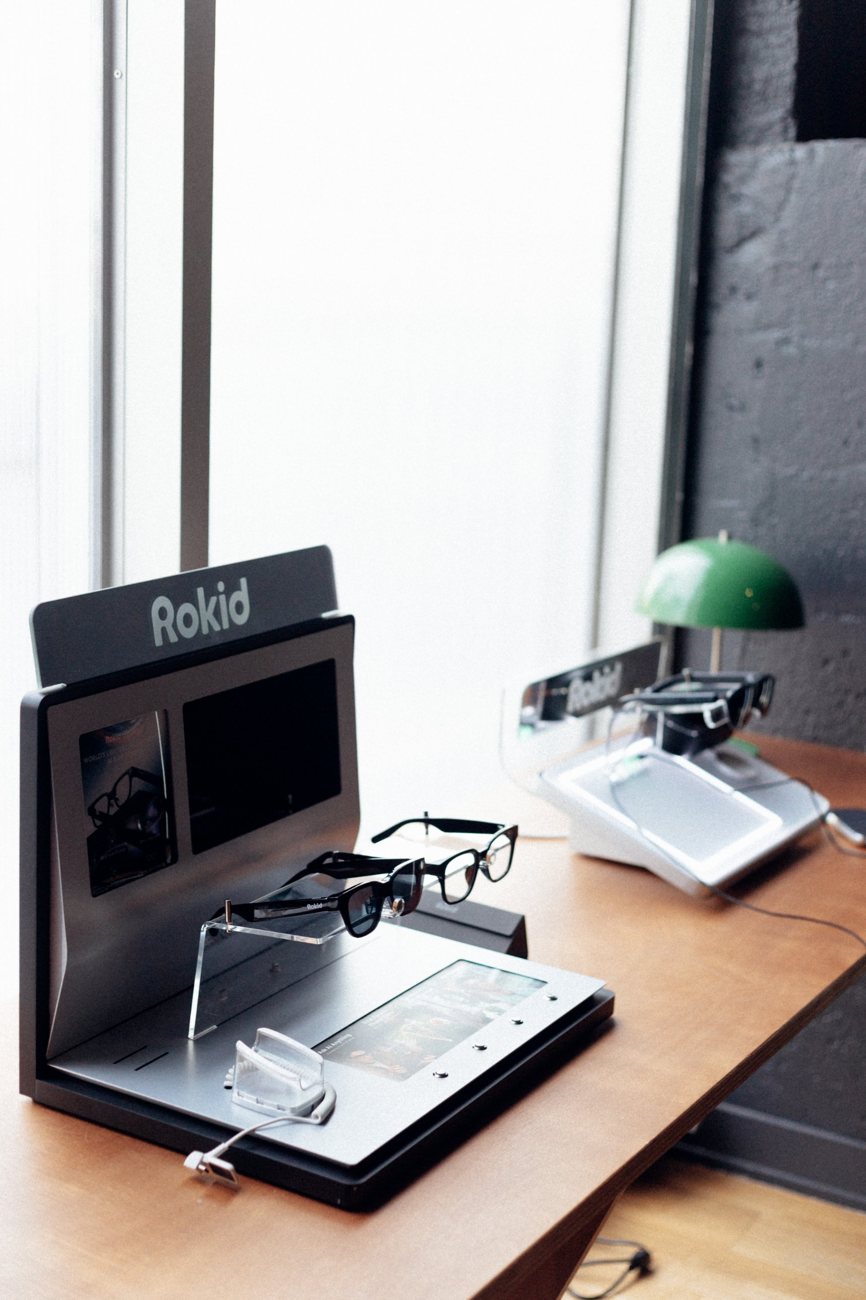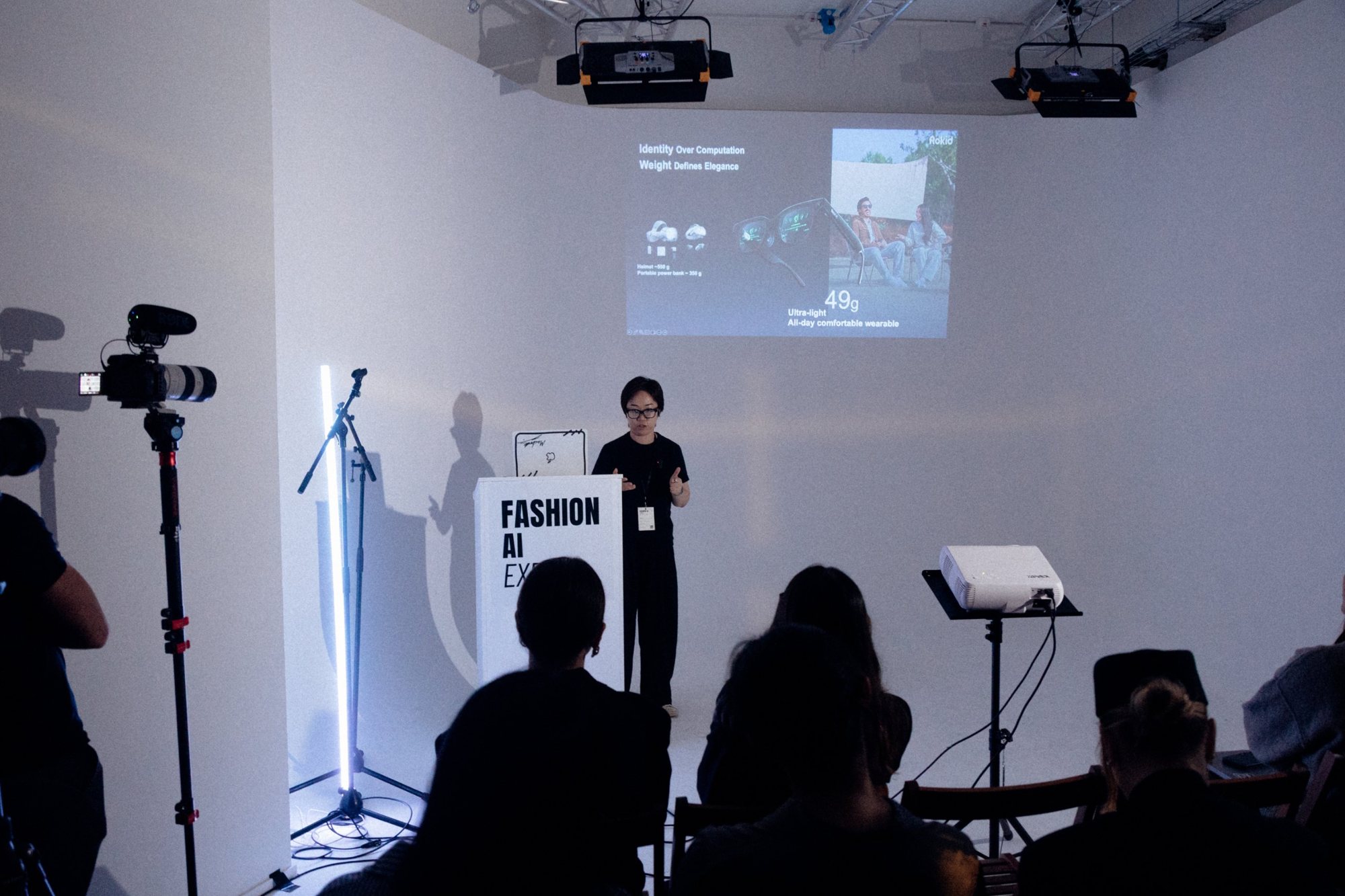
At Fashion AI Expo Paris, Xuejiao Ou of Rokid showed how AI and AR glasses could become part of a fashion professional's everyday kit, from backstage to the front row, if they first become something people actually want to wear.
Halfway through her talk at Fashion AI Expo, Rokid ambassador Xuejiao Ou made a confession. Since stepping on stage, she had not memorized a single word, and she held no notes, phone or tablet. Her talking points were floating in front of her eyes, in the display of the glasses she was wearing, scrolling with her voice while she kept eye contact with the room.
It was the most convincing argument of the session: the technology was working, and nobody had noticed.
Design First
For wearable tech to matter in fashion, she argued, it first has to look like something you want to wear outside. For decades, devices have been heavy helmets and bulky straps that say "look at my hardware" rather than "look at me". "Nobody wants to look like a robot when grabbing a coffee with friends or with your clients."
The glasses she wore weigh 49 grams, the weight of regular sunglasses, with transparent lenses and a camera, battery, speakers, touchpad and an invisible display built in. "We believe weight defines elegance."
We believe weight defines elegance.
Xuejiao Ou, RokidFive Ways Glasses Could Work for Fashion
- Backstage. A creative director could manage a 40-model runway sequence without holding a clipboard. Minutes before a red carpet, a stylist could guide talent through final interviews, with brand credits and high-jewellery details scrolling discreetly in view. Hands stay free and eye contact stays intact.
- Trade without language barriers. Paris Fashion Week brings together buyers from Seoul, artisans from Florence and press from New York. When someone speaks Korean, live English subtitles appear in your view. "I never have to look down at the phone screen. I see their smiles, catch every subtle tone and close the deal."
- Inspiration in a glance. At a show or in a showroom, a designer can look at a piece and ask the glasses to analyze the silhouette and extract the colour palette. In seconds, she said, the vision model reads the textile, suggests the Pantone code and saves it to a mood board. "Just glance, capture, and create."
- Fashion in three dimensions. "Flat images on the phone screen, that's yesterday. Fashion lives in 3D." She described AI that understands how fabric drapes and moves on a body, so a whole show, its fits and walks, could be tested in 3D before the fabric is even bought.
- A front row without walls. A show need not be limited to the chairs in a Paris venue. A collector in Tokyo, a buyer in Shanghai and an editor in New York could share the same front-row view through AR glasses, with details such as craftsmanship notes and delivery dates appearing as each look passes, and a gesture saving it to a wholesale order.
Some of this already exists in culture. At an exhibition of Chinese intangible cultural heritage in London in September, she said, visitors used AI and AR glasses to discover the heritage behind each craft in their own language.
An Open Platform
Rokid's glasses connect to leading AI models, so users can choose, for example, ChatGPT, Gemini or DeepSeek. According to the company, more than 3,500 developers worldwide build for its platform, and an agent store offers a growing library of AI agents.
With AIUI Studio, anyone can build an interactive agent in plain language, without code. Unlike a chatbot that answers in text, these agents show a visual interface: market charts, a fitness coach while cycling, navigation, song lyrics. Ou also described "vibe coding" in the glasses: say "make me a clean timer app with a blue button", and the app appears in front of you, ready to resize with a pinch. "Coding or designing is no longer about sitting and typing."