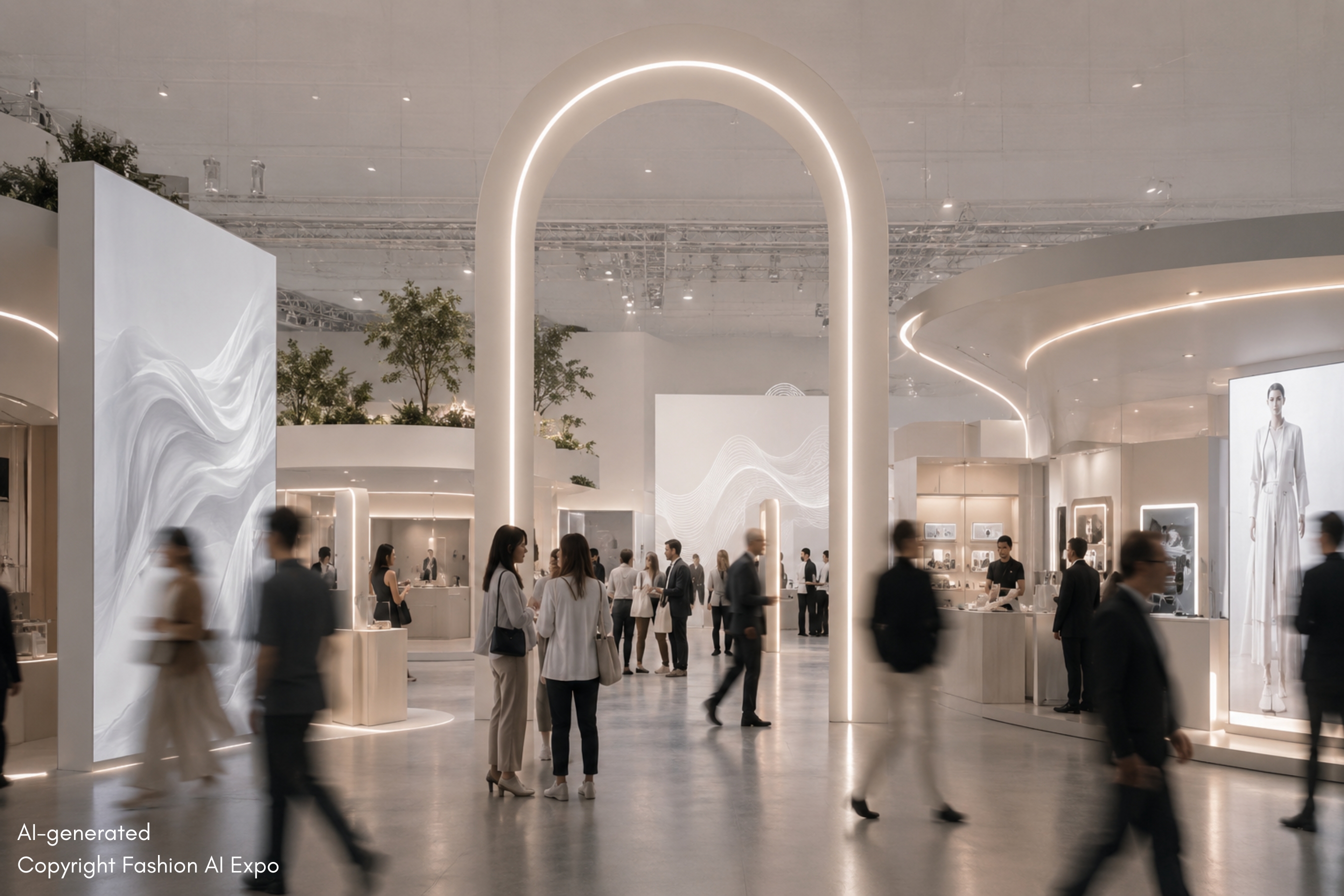
Where fashion and AI are actually meeting.
VivaTech has never been a fashion event. That is precisely what makes it worth reading closely. Every June, the show floor becomes a kind of pressure test for where technology is actually going — and this year, one signal was impossible to ignore: fashion is no longer a guest category at VivaTech. It is becoming one of its most active laboratories.
Over three days, Fashion AI Expo spoke with founders, strategists and technologists building tools that touch nearly every stage of a garment's life — from the fiber to the final product photo. What follows isn't a company directory. It's a reading of the patterns that kept resurfacing, conversation after conversation.
Try-On and Fit Have Become Infrastructure
Virtual fitting dominated more conversations than any other category this year. What's changed isn't the concept — try-on has existed in some form for years — but its positioning. It's no longer pitched as a novelty demo; it's pitched as checkout infrastructure, with return rates and conversion metrics doing the talking instead of the visuals.
The technology itself is also converging across categories — the same underlying AR/AI engines increasingly power try-on for makeup, hair, eyewear, jewelry and apparel alike, rather than staying siloed by product type.
AI Is Rebuilding Commerce Content From the Ground Up
A second, equally strong cluster is dismantling the traditional content pipeline. Some approach it through generative AI paired with physical automation — robots that shoot and edit product photography without a human photographer. Others are building toward something broader: unified systems that combine styling logic, virtual fitting and content generation into a single operating layer, rather than treating them as separate tools bolted together.
The throughline is the same regardless of approach: the cost of producing imagery at the speed e-commerce now demands has become a well-understood, well-funded problem, and there's no single accepted way to solve it yet.
"Fashion is no longer a guest category at VivaTech. It is becoming one of its most active laboratories."
Design-to-Manufacturing AI Is the Least Visible, Most Consequential Layer
Away from the consumer-facing demos, a quieter and more technically ambitious group is working further upstream — closer to the factory than the feed. This is AI applied to textile digitization, sampling, and the design-to-production pipeline itself: turning physical fabrics into digital twins, connecting designers to suppliers before bulk orders are placed, and compressing production timelines that have historically taken the better part of a year.
This is the layer that changes how long it takes to make fashion, not just how it's sold. It's arguably the most consequential shift on the floor, and the one that gets the least attention — it doesn't demo as well as a robot taking a photograph.
Styling Intelligence Is Splitting Into Two Different Products
AI styling tools are diverging into two distinct categories, and it's worth naming the difference. One type is built for brands: private trend intelligence and content tools meant to help a business spot what's next and act on it quickly. The other is built for consumers: public, social, often gamified platforms where people get style feedback, share outfits, and shop community-driven drops — closer to a social network with a stylist built in than a private wardrobe tool.
The two get pitched with similar language but solve genuinely different problems for genuinely different customers.
AI Is Becoming a Creative Medium, Not Just a Production Tool
Not every interesting use of AI on the floor was about solving a cost problem. A smaller but distinct group is using it as a genuine creative medium — a way to generate campaign visuals, art direction and visual concepts that would be difficult or impossible to produce by traditional means, rather than simply automating an existing process.
The most interesting work here isn't AI replacing a photographer or a director. It's AI used the way a brand might use any other material — paired with human direction, taste and editing to produce something with its own visual language. The output isn't faster or cheaper content. It's different content: campaigns and imagery that couldn't have existed the same way five years ago.
It's a useful reminder that "fashion-tech" doesn't only mean efficiency. Sometimes it means a new tool for self-expression — one more instrument in the hands of the people actually making the creative decisions.
The Ecosystem Around the Technology Is Its Own Category
Not everything worth noting was a product at all. A meaningful share of the most useful conversations were with people building the human infrastructure around fashion-tech rather than the technology itself — professional networks and forums convening designers and technologists, and specialist agencies that help Western brands navigate entry into Asian markets.
Technology needs distribution and translation as much as it needs innovation, and this layer is where that happens.
"Fashion-tech is no longer a pitch. It's becoming infrastructure."
Technologies Are Starting to Converge
Perhaps the most interesting pattern wasn't any single category, but the way the boundaries between them are beginning to disappear. Just a few years ago, virtual try-on, content generation, design software and manufacturing platforms existed as separate products solving separate problems. At VivaTech, those lines felt noticeably more blurred.
Increasingly, companies are building connected workflows where AI follows a garment across multiple stages of its lifecycle — from design and material selection to sampling, product imagery, styling and commerce. Rather than adding another isolated AI feature, many teams are trying to become part of a broader operating system for fashion.
The industry appears to be moving away from point solutions and toward integrated ecosystems, where information flows continuously instead of being recreated at every step. If that direction continues, the biggest transformation won't come from any single breakthrough technology. It will come from the connections between them.
What This Adds Up To
No one on the VivaTech floor was trying to "disrupt fashion" in the abstract. Almost everyone was trying to solve one specific, unglamorous cost center — returns, content production, sampling time, or design-to-production speed — with AI applied precisely rather than broadly.
That, more than any headline demo, is the real signal from this year's show floor: fashion-tech is no longer a pitch. It's becoming infrastructure.
The next phase of fashion AI won't be defined by the companies with the most impressive demos. It will be defined by the technologies that become almost invisible because they quietly solve problems every brand already knows it has. That's exactly the conversation we want to continue this October at Fashion AI Expo.
See you in the next article.