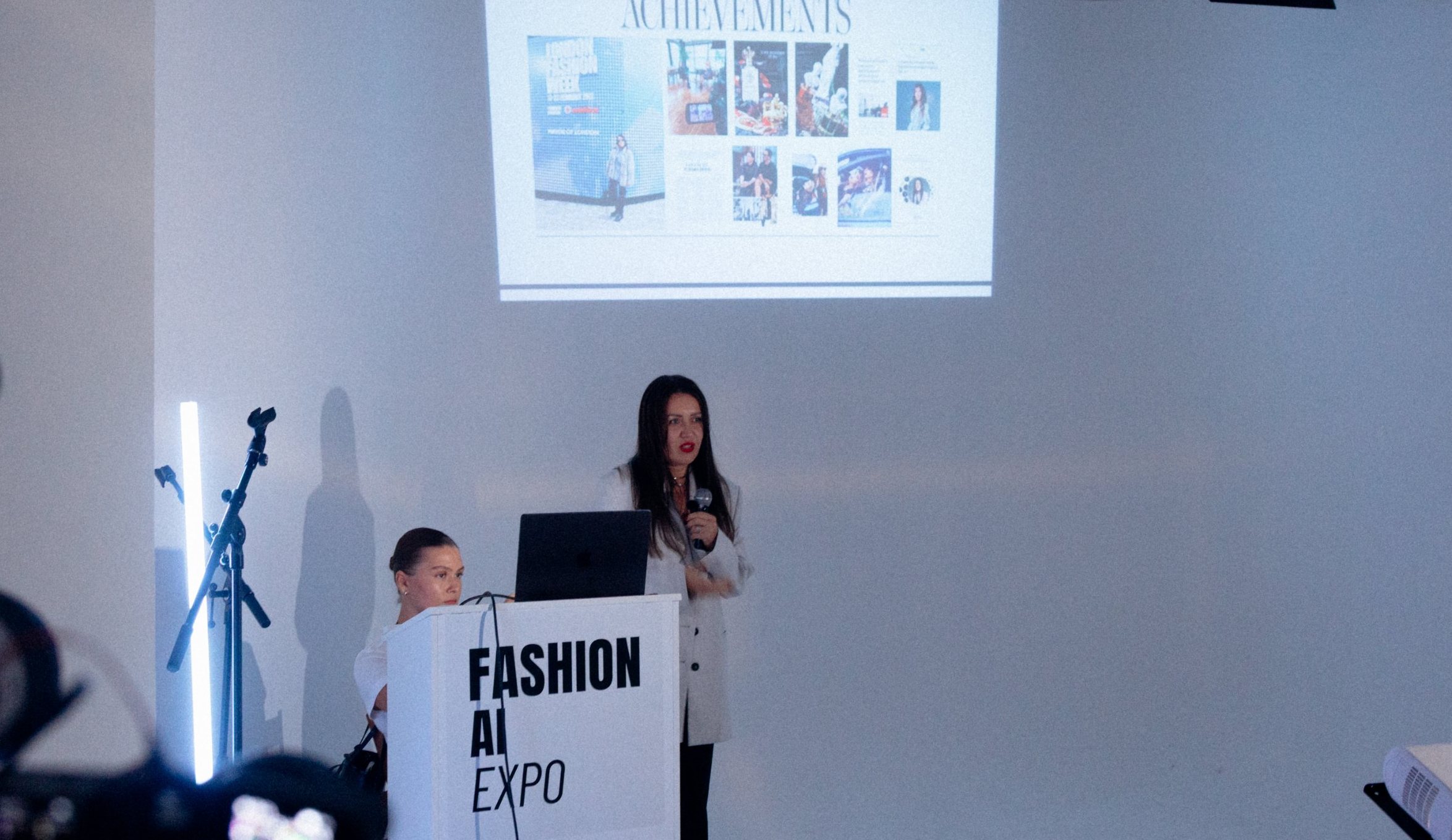
At FAIE Paris, Ana Varava, CEO of Fashion Consulting Group and former L'Officiel Ukraine editor-in-chief, argued that AI can write about fashion but cannot live it. The trust, taste and judgment that make fashion media work are still human. In the age of AI search, they matter more than ever.
It was one of the few talks of the day that put the human side of the equation on stage. Ana Varava, CEO of Fashion Consulting Group and former editor-in-chief of L'Officiel Ukraine, has spent more than 18 years in fashion media. She launched L'Officiel in Austria, and more recently ELLE Uzbekistan, and advises fashion and lifestyle brands.
Ana's message at FAIE Paris, on 2 October 2026 at the Artistic Palace, came down to one line: "AI is your hands, but you are the mind and the heart."
AI is your hands, but you are the mind and the heart.
Ana Varava, Fashion Consulting GroupExperience Can't Be Copy-Pasted
She began by separating the two words in "fashion media". Media is facts. Fashion is emotion. Fashion media, then, is a personal voice: how a creative person sees a collection, a shoot or a show.
That is why brands don't simply send press releases. They invest in experiences. They fly editors to shows around the world, stage a Chanel Cruise show in Cuba, or open the Louis Vuitton house for a shoot. They want someone to live the brand and pass that feeling on to readers. "You can write about the brand universe," she said, "but you can't experience it." Experience can't be lifted from a press release, and it can't be made by AI.
The same logic governs who gets to tell the story. When she launched L'Officiel in Austria, houses like Chanel and Louis Vuitton came on board because they knew her. Fashion works with people it knows and trusts. Her advice to tech founders was direct: a great idea is not enough. Without people inside the industry who understand how it operates and will vouch for you, the door stays closed.
Why Magazines Still Matter
She gave three reasons magazines keep their power.
- Validation. A feature in an international fashion magazine is still the strongest credibility signal a brand can earn.
- Permanence. A printed page can't be deleted tomorrow. It stands as proof. Online content can disappear overnight.
- Artistic vision. A magazine is not just text. Its fashion stories bring stylists, photographers and editors together as a creative team, each with an attitude and a style that AI cannot easily reproduce.
AI Needs the Expert
AI, she argued, is only as good as the person prompting it. Take Demna's Gucci collection. Anyone can ask a model to write about "an amazing Gucci collection" and get the same generic text as everyone else.
An expert knows to ask for more. Compare it with the Tom Ford years. Set it against Frida Giannini's era. That knowledge of fashion history is what turns AI into a professional tool. "You have to be an expert to work with AI as well in fashion."
Visible to People and to Algorithms
Her most practical point was about AI search. AI assistants build their answers from trusted sources, and credible media is one of them. If a brand has been published, it gets credit and becomes visible in AI answers. If not, it risks being dismissed as an unreliable source. This is the logic of generative engine optimization: earned media now speaks to algorithms as well as to people.
Nor did she set traditional and social formats against each other. Reels bring reach. Articles bring depth and credibility. The strongest approach combines both: an expert article, written with the help of AI, then promoted through reels. "One expert voice, two formats": it spreads wide and stays credible.
Editors Are the Human Filters
With almost unlimited AI-generated content, editorial judgment becomes more valuable, not less. She pointed to a recent event in Milan that put humanoid robots in front of editors. The expected "wow" never came. The human touch still mattered more.
COVID taught the same lesson. When nobody could leave home, brands moved their shows online. Today more shows are physical than ever, and some houses once thought dead are being revived by new owners. Seeing a collection on a screen and seeing it live are "super different feelings". Fashion, she said, is a kind of theatre.
How Fashion Tech Gets Featured
For tech companies hoping to reach editors, she offered an editor's checklist:
- Find the fashion angle. Tell a story, not a product spec, and explain why it matters, for example for the environment.
- Know the magazines: their sections and their editors.
- Find people who will connect you. Industry insiders who trust you and will present you.
- Prepare a press kit and quality images.
- Plan ahead. Monthly titles work three to six months in advance.
- Build real, human relationships. People move between brands, but the connections last for years.
The Mind and the Heart
In the Q&A she was asked whether humans and AI are rivals. Her answer: "If we are smart, we will be friends and cooperators." The technology revolution can't be stopped, but AI still learns only from the past. It can predict, but it can't feel, and it can't invent something new. That is why she sees AI styling as a mass-market tool. Styling yourself is a creative game people want to play themselves.
Her conclusion was simple. Magazines give validation and artistic vision. Trusted media is visible to people and to AI. Editors remain the human filters. "AI can create a text for you. But only people can create living content."
Or, as she put it with a smile:
Humans won. Still, we will see what happens next.
Ana Varava, Fashion Consulting GroupSee you in the next article.