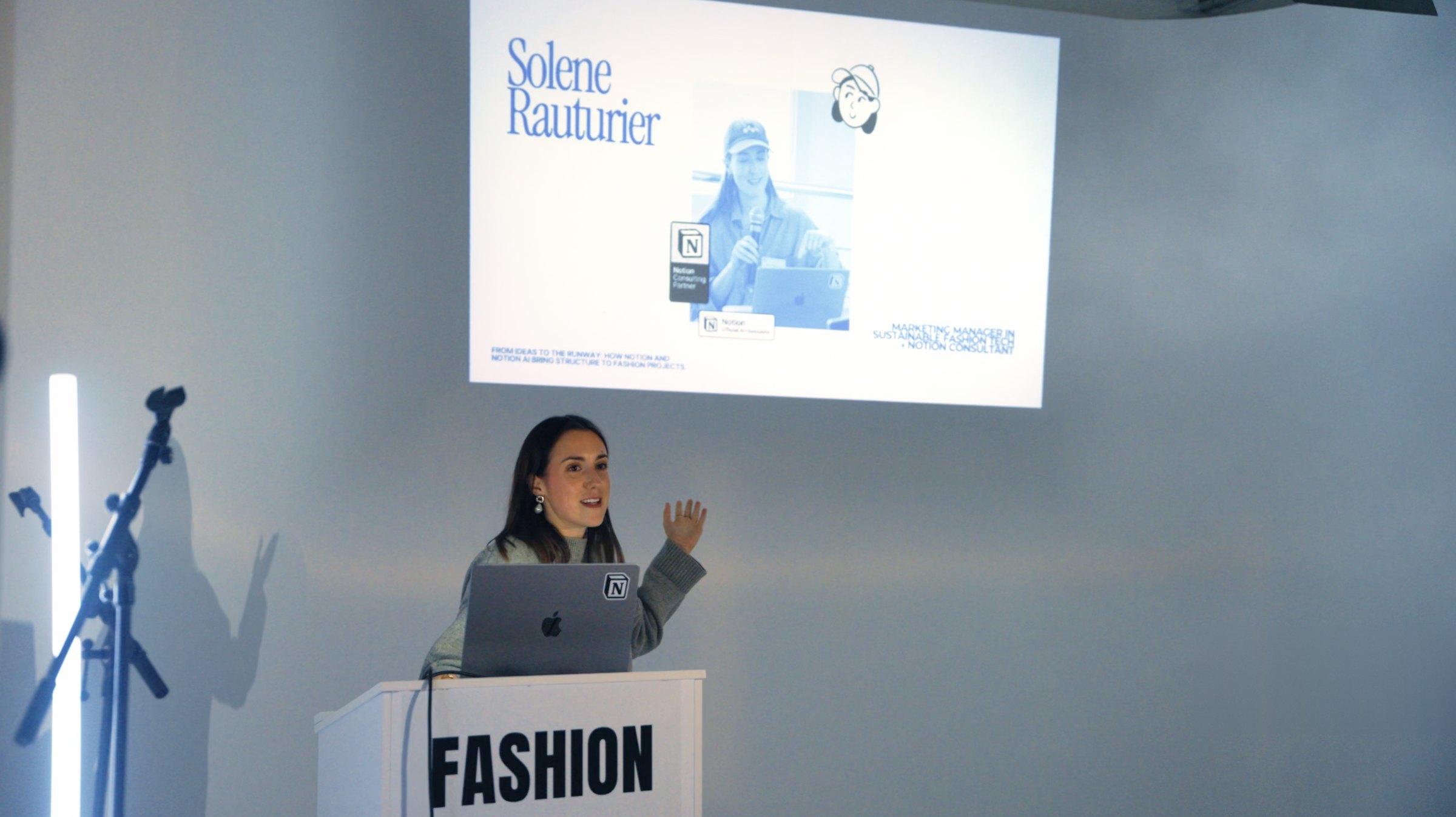
At Fashion AI Expo Paris, Notion consultant Solène Rauturier showed how fashion teams can give every project one structured home, and why that structure is what makes AI truly useful.
After a day of talks on style, imagery and virtual try-on, Solène Rauturier turned to a less glamorous subject that every fashion team knows well: getting the work done. Her session at Fashion AI Expo showed how Notion and Notion AI can bring structure and productivity to fashion projects, from the first idea to the launch.
Solène knows the industry from the inside. Before becoming a Notion consultant and ambassador, she was marketing manager at a sustainable fashion-tech startup. Today she helps organizations turn scattered tools and messy processes into clear systems. "My job is not simply to make Notion look pretty," she said. "It's to make work easier to understand and easier to move forward."
When Work Spreads Everywhere
Every fashion project begins with an idea: a collection, a campaign, an event, a new product. Then, Rauturier observed, the work starts to scatter. The brief arrives by email. Feedback comes through WhatsApp or Slack. Deadlines live in a spreadsheet. Multiply that by every project a team runs in a year, and AI is often brought in as a last attempt to make sense of it all.
The symptoms are familiar. Where is the latest version? Who was supposed to work on this? Where are we with this collection? The cost, she said, is not only time but headspace.
Her answer is simple: give the work one clear home. When projects, tasks and content live in one connected place, everyone can see what is happening, what comes next and where they need to contribute. And the same context that helps the team also helps AI.
Think of Notion as Legos for work.
Solène Rauturier, Notion consultantLegos for Work
Compared with tools such as Trello, Monday, Asana or a classic spreadsheet, which impose their own structure, Notion is built to be flexible. "Think of Notion as Legos for work," Rauturier said: a set of blocks a team assembles into the system that fits how it actually works.
To show what that looks like, she presented Fashion Brand OS, a workspace she built with the help of Notion AI to run a brand's work from first idea to launch.
- Projects and collections. Each one has its own page holding all its context, so the team no longer searches through messages to find a brief.
- Tasks. Every task is linked to its project, with an owner, a due date and a priority. Breaking a collection into small pieces makes it easier to deliver, and moving a task to "done" tells the whole team where things stand.
- Timeline. The same tasks appear on a timeline that shows overlaps and delays. When one task slips, the tasks connected to it move too.
- Content calendar. Posts and content are planned around each launch and linked to the project.
- Personal dashboards. Sharing one workspace does not mean everyone sees everything. The same data is filtered so each person sees their own projects, tasks and content: the right information, in the right place, at the right time.
The point, she stressed, is not her exact setup. A team that needs to track something else can build that too.
Context First, Then AI
Only once the work is structured does Rauturier add the AI layer. "With any AI tool, the most important step is giving it context," she said, and structuring that context. Because the information already lives in Notion, AI can work directly where the team works.
Her first example is always AI meeting notes. Notion AI transcribes a meeting, summarizes what was discussed and lists the action items, and the notes sit next to the projects and clients they belong to.
The built-in assistant goes further. Asked "Where am I with my latest collection?", it read her projects, open tasks and planned content, and summarized where the collection stands. Users can choose which language model to use depending on how complex the task is. Notion AI also drafts: the project context pages in her demo were written by AI from content already in the workspace, so no one starts from a blank page.
With any AI tool, the most important step is giving it context.
Solène Rauturier, Notion consultantAgents: Assistants with One Job
The next step is custom agents, which Rauturier described as "little assistants or team members" programmed to do one specific task when something specific happens.
For one client, she built a morning brief. Every morning, an agent reviews what each team is working on, including open projects and tasks, and sends the CEO a summary of the whole organization.
In her own workspace, an agent closes the gap between a meeting and the work that follows. Action items in a meeting summary are easy to forget. So when she marks a meeting as done, the agent reads the summary, creates real tasks in her task database, links them to the right client and schedules them on the days she reserves for client work. "I can be fully present with the client during the call," she said.
What It Means for Fashion Teams
Rauturier was clear about the limits. "AI does not replace your creative teams and your humans," she said. Notion AI is good at searching, sorting, summarizing and repetitive tasks. Its value is in removing friction, so teams have more time and energy for the work only people can do.
She also described a good system as never finished: "a living and breathing entity" that evolves as workflows change, teams grow and the tools add new features.
For fashion brands juggling collections, campaigns and content across a dozen apps, the lesson is practical. Instead of ten disconnected places, one shared system can carry a project from idea to the runway. And the better that system is structured, the more AI can help.
Attendees left with a QR code to download the Fashion Brand OS template and try it with their own teams.
Solène Rauturier, Notion consultant and ambassador, led a practical session on Notion and Notion AI at Fashion AI Expo Paris on 2 October 2026, during Paris Fashion Week, at Artistic Palace.
See you in the next article.